
Property Partition Laws and Process in Nepal: Legal Guide 2025
Property Partition Laws and Process in Nepal: Legal Guide 2025
This article provides a comprehensive overview of the Property Partition in Nepal process, covering both voluntary and court-mandated division, and is structured to be easily understandable for those seeking legal guidance.
1. Background
The concept of Property Partition in Nepal (Anshabanda) dictates the legal division of joint family property among individuals who have a birthright or marital right to a share. This process ensures the equitable distribution of ancestral assets (Moveable, Immoveable & debt) and is governed by the Muluki Civil Code, 2074 (2017).
This guide article outlines the fundamental principles, legal framework, eligibility, and step-by-step procedures for conducting successful and legal remedy on joint family property in Nepal.
2. Definition
The division of ancestral and parental property, whether moveable, immovable, or loan/debts of the family will be parted/divided among the main coparceners is known as property partition, also called Anshabandaa.
Note: Coparceners are Anshiyar, who hold the right to the parental property.
For any partition to be considered legally valid, Mandatory Deed of partition must be made and registered in concerned office/ Inland Revenue Office (Malpot) fulfilling all legal requirements. Absence of this remains legally unpartitioned.
3.Governing Law
The National Civil Code, 2017 governs the matters related to property in Nepal. Chapter 10 'Provisions Relating to Partition' of the code specifically contains the legal provisions relating to property partition. The chapter includes Section (205-236).
4.Governing Authority
Inland Revenue Office (मालपोत कार्यालय)
The district-level Courts (जिल्ला अदालत)
Ward Office for property tax and other recommendation
5. Main Coparceners in the Family
Main coparceners are equally and legally holding the right to parental property and major coparceners are mentioned below:
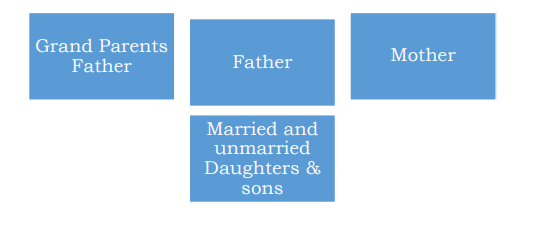
Special Eligibility Notes:
Married Daughters: Daughters who were married on or after October 10, 2015 (2072/06/24) are legally entitled to claim property rights from their parents. Property claim this days has been increasing and Property lawyer have been assisting to married daughters in fighting for their property rights.
Unborn Child: If a woman coparcener is pregnant during the partition process, a share must be legally reserved for the unborn child.
6.Divisible Property for Partition
1. Property inherited from ancestors (Paternal or maternal lineage)
2. Property Owned by the coparceners except the private property
3. Property earned by coparceners using the common investment or ancestor money to earn trade, industry or business in common.
4. Property acquired from joint family using joint properties
Crucial Note on Debt Liability: All coparceners are equally liable for the family’s outstanding loans and debts, which must be divided and settled equally during the partition process.
7. Non-Divisible (self-acquired) Property
Situations where Coparcener are not liable for Partition of their properties legally among coparceners;
- Private properties legally registered after partition in the authority (Malpot)
- Self-earned Properties from verifiable income.
- Properties acquired by daughter-in-law from her maternal families.
- Properties received from donation or lottery by the coparceners
- Intellectual Properties or Royalty received
- Provident fund, remuneration, pension, insurance or social security
- Property earned by women before marriage, acquired from parental side during or after marriage
- Property owned by woman by husband or with consent of coparceners of husband side that she have right in it.
- Exclusively Private property of a person.
- Property acquired while living apart by separating bread and board in accordance with law.
8. Specific Circumstances of Obtaining Parental Property:
Specific Circumstances under which parental and ancestral property may be obtained includes:
8.1 Property Rights of Children from Annulled/ Invalid Marriages:
Children born from marriages that are legally invalid, cannot be performed, or have been annulled are still entitled to inherit property from their biological mother and father.
8.2 Children born from couples with ended marital relationship:
Children born from couples whose marriage cannot recognized legally or whose marital relationship has ended shall receive a share from such mother and father.
8.3 Children property right is entitled from mother:
In case children father's identity is not established shall receive property only form mother's property.
8.4 Complexities in Parental Marital Status:
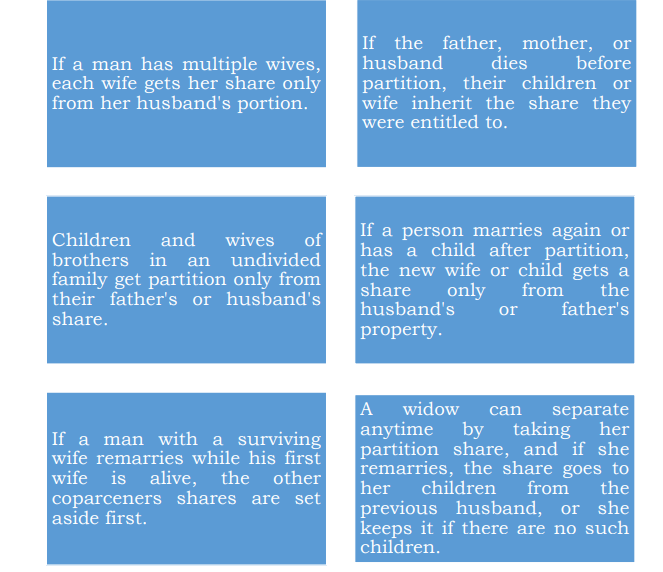
9. Coparceners are liable to get the property any time if parents are not taking the responsibility well to them.
Note: Properties also loans/debts of the family shall be divided to all coparceners equally.
10.Two Major ways to Property Partition:
Property or debt among family members can be divided in two ways: first, through mutual cooperation, and second, through the court process.
i. Mutual Partition
ii. Court Process
10.1. Mutual Partition (Amicable Agreement):
Smooth method when all the coparceners cooperate and agreed in shares portion mutually.
Process: Property Lawyers asset you in drafting the partition deed/agreement and all the coparceners register it in the malpot office.
Note: If a coparcener is not able to appear physically in the authority, he or she shall appoint authorized attorney in accordance with Law.
If any coparceners are not satisfied with the mutual partition of properties, they can file a case in the court for unequal discriminatory partition within 3 months of legal partition of shares.
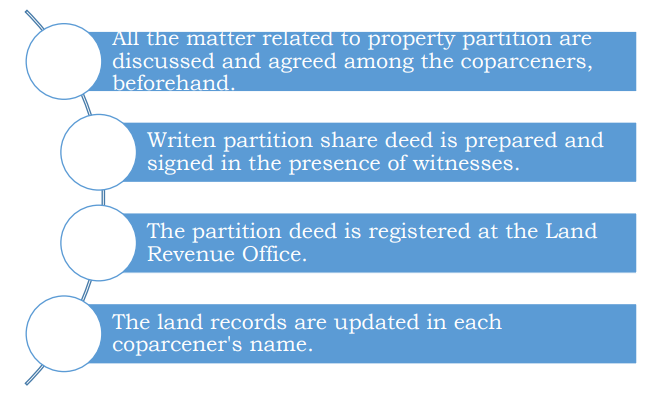
10.2. Partition Though Court Process (Non-Amicable):
When conflict arises, or consent cannot be received during the partition of the parental property, the coparceners have the option to seek judicial help for an equal, fair, and unbiased partition of the property among themselves. The process is as follows:
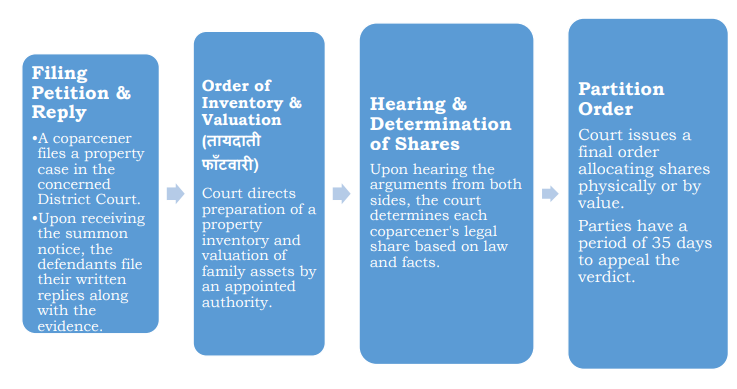
10.3. Relinquishment (Give-up) of Share:
Any coparcener may by executing a deed in effect relinquish his or her partition share with or without taking his or her partition share instead exchange with cash partially. This requires that consent must be taken from their immediate family members (Wife, and children) but minor coparcener share never be relinquished.
Note: Minor coparcener to partition share may not be relinquished.
10.4. Wife and Husband (father and mother) Property Partition
Husband and wife shall separate their share portion at any time in following circumstances:
i. If either husband or wife expels each other from house
ii. If causes mental torture to either
iii. With the consent with each other.
Daughter in-law or wife gets partition from her husband's shares part, dividing with all existing children, husband, wife equally after partition of properties from main coparceners of the joint family.
Note: If husband and wife have got their portion of partition legally from Malpot or concerned authority, they can live separate and move ahead in their life, also can conduct marriage with another woman. No bigamy (Bahuvivha criminal case can be registered)
11.Prohibition on Concealing or hiding Property:
If any coparcener conceals or hide property which is held in his or her name and is liable to partition at time of effecting partition or at time when asked by court to submit inventory, other coparceners have right to obtain such property excluding who hides properties.
12. Legal Remedy for Property Disputes:
| Dispute Type | Legal Time Limitation |
|---|---|
| Unequal Partition | Case must be filed within 3 months of legal partition registered |
| Partition during coparcener was minor | Case must be filed within 6 months after the minor attains adult |
| Concealing or hiding property | Case can be pursued until the coparcener's life exists |
| Partitionable property sold without consent of other coparceners | Must file case within 6 months |
Important Note: Remaining coparceners have right to obtain property excluding the one who concealed property during partition.
13. Conclusion:
Property partition in Nepal is a critical and multi-faceted legal obligation governed by the Muluki Civil Code, 2074. A properly executed and registered partition provides clarity, security, and legal recognition, protecting every coparcener's future rights and minimizing future disputes.
As these matters often carry significant financial and emotional complexities, seeking timely professional legal consultation from our experienced Family Lawyers is highly recommended. Our experienced property lawyers are prepared to assist your family in navigating documentation, mutual agreements, court filings, and ensuring compliance with the law.
If you require assistance with property partition, documentation, court filings, or legal representation by property lawyers in your property disputes in Nepal, professional guidance from our experienced property lawyers feel free to Contact us via. [email protected] or can call us on +9779841933745 (available in whatsapp and viber too)
This article is intended for general informational and educational purposes only and does not constitute complete legal advice. Property partition laws in Nepal may vary based on individual circumstances, factual situations, and updates to the Muluki Civil Code or related regulations. Readers should not rely solely on this content to make legal decisions. For accurate guidance tailored to your specific case, please consult our Property lawyer or legal professional in Nepal.
For quick legal assistance:
You can directly call to our legal expert: +9779841933745
Even can call or drop a text through What's app , Viber, Telegram and We Chat at the same number.
Also can do email on : [email protected]
Get in Touch with Our Legal Experts
Have a question or need legal assistance? Fill out our contact form and our team of experienced lawyers in Kathmandu, Nepal will get back to you promptly.
Please include your WhatsApp or Viber number in the phone section if you'd prefer a direct call from one of our legal professionals.
We are here to provide trusted legal support tailored to your needs.
Phone : +9779841933745, +9779841933745
REACH OUT TO US AT ANY TIME
More Publications