
Court Process for Obtaining Legal Guardianship in Nepal
Court Process for Obtaining Legal Guardianship in Nepal
1. Definition as per the Nepalese Law
A person who is appointed or liable under the Nepalese law to protect the rights and interests of, or protect an incompetent or quasi competent person, shall be considered to be a guardian. Legal guardianship appoints an individual to make decisions and manage the property of a minor or a person of unsound mind. This legal provision ensures the protection and proper upbringing of the ward, and the prudent management of their assets.
2.Governing Law
National Civil Code, 2017
3. Governing Authority
The District-level Courts appoint and issue a guardianship certificate.
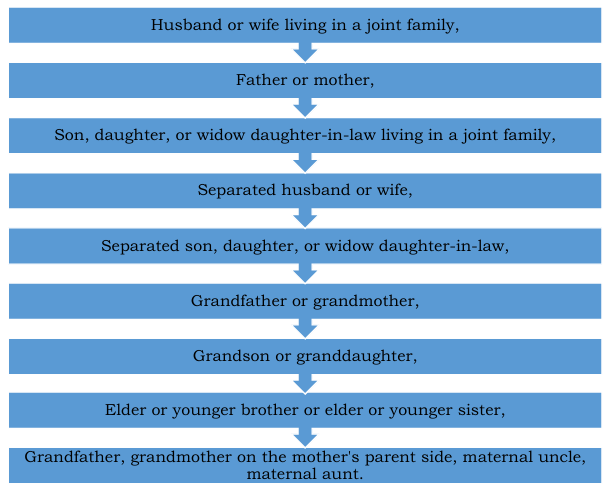
4. Criteria to become a Guardian in priority order
The Law governing guardianship of an incompetent or quasi-competent person sets a priority order for who may become a guardian, ipso facto, as follows:
5. Other Eligible Guardian
If any person, not included in the priority list, has been taking care of an incompetent or quasi-competent individual, they may be considered their guardian, with court approval or recommendation of chief district officer.
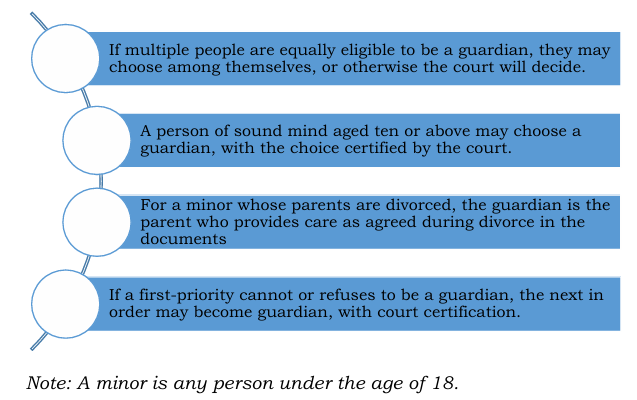
6. Designation of Guardians in Specific Circumstances
The Law sets out the following specific circumstances where the guardians are chosen differently (not in the priority order):
7. Artificial Person (Organization) to be considered a guardian
If a child is living in a registered welfare place like an orphanage, child home, or similar organization and has no guardian, that organization becomes the child's guardian. The chief of the organization is responsible for making decisions and taking actions for the child.
Note: The term 'chief' refers to the chief executive officer of that organization or the chairperson, general manager, managing director or other officer acting in that capacity.
8. Considerations taken by the court while appointing a guardian
While appointing a guardian, the court takes the following considerations:
i. The court ensures that the rights, interests, and protection of the incompetent or quasi-competent person are protected.
ii. The court must also get the consent of the person chosen as guardian.
9. Process of obtaining Legal Guardianship
- The process to get appointed as a legal guardian by the court is as follows:
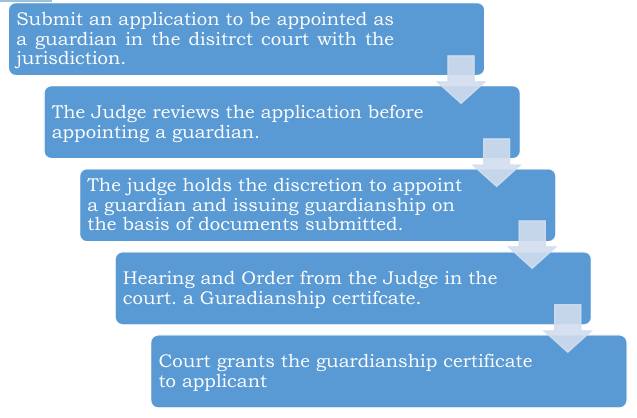
Note: The court expects the incompetent or the quasi-competent person to be present in court with other guardians verbally give their consent to the judge.
10. Court Order & Certificate:
• Following the investigation and hearing (or agreement), the court issues a formal Guardianship Order. This order clearly specifies the guardian's rights, responsibilities, and the scope of their authority.
• A Certificate of Guardianship is then issued, which is a crucial legal document.
• The guardianship must be registered with the court, than it must be verified with different authorities or relevant local body to ensure its official recognition and enforceability.
11. Required documents for Guardianship Certificate from Court
1. Petition draft
2. Minor ID cards or education certificate
3. Birth registration of Minor or child
4. Citizenship of Applicant
5. Ward Office Recommendation on custody.
6. Death certificate if any 6. Relation verification documents
7. A consent Letter from minor or physical presence in court
8. Power of attorney (POA) if applicant is in foreign country
9. Divorce document of court if parents are divorced.
10. Temporary residence recommendation if necessary
11. PP size photos 3 each
12. Two Witness
12. Rights of a Guardian over an Incompetent or Quasi-Competent Person
.The rights of a guardian are:
- Right to care and protection
- Right to Residence includes the right to move the person abroad.
- Right to Manage Property
- Right to Represent Legally
- Right to Consent such as medical treatment or legal agreements.
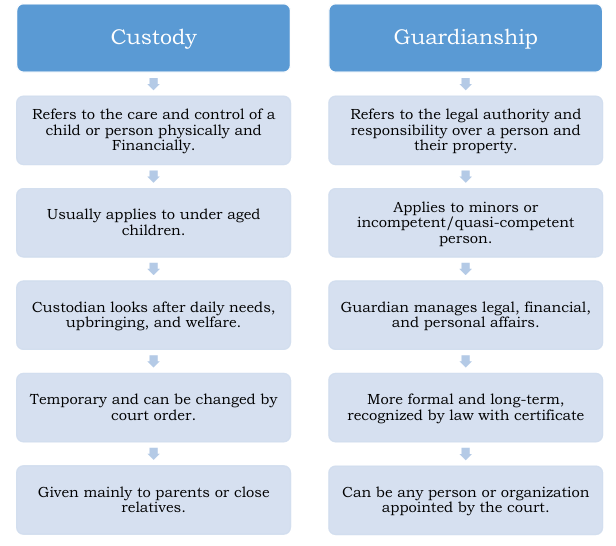
13. Difference between Custody and Guardianship
When the parent with custody of the children hinders the other parent's right of visitation or does movement of child without consent of custodian the custodian parent can file a writ of habeas corpus (बन्दिप्रत्यक्षिकरण) in court.
Single parent who is taking custody of child, if desires to move or migrate the child to foreign country or outside the country, another parent must provide consent or agreement is required along with court guardianship certificate.
14. When one parent stops the other from meeting the child?
When the parent with custody of the children hinders the other parent's right of visitation or does movement of child without consent of custodian the custodian parent can file a writ of habeas corpus (बि द यि करण) in court.
15. Single parent who is taking custody of child
Single parent who is taking custody of child, if desires to move or migrate the child to foreign country or outside the country, another parent must provide consent or agreement is required along with court guardianship certificate.
16. Conclusion and Call to Action:
Appointment of Legal Guardianship is governed by the Muluki Civil Code, 2074. A properly executed legal guardianship provides clarity, security, and legal recognition, protecting child best interest and future rights and minimizing future disputes.
As these matters often carry significant financial and emotional complexities, seeking timely professional legal consultation from our experienced Family Lawyers in Nepal is highly recommended. Our experienced Family lawyers are prepared to assist your family in navigating documentation, mutual agreements, court/application filings, and ensuring compliance with the law. Legal guardianship Certificate requires not just an understanding of the law, but also nuanced application, meticulous documentation, and strategic representation. At Lawin & Partners, we pride ourselves on delivering comprehensive and client-centric legal services.
This article is intended for general informational and educational purposes only and does not constitute complete legal advice. Guardianship/ custody of child in Nepal may vary based on individual circumstances, factual situations, and updates to the Muluki Civil Code or related regulations. Readers should not rely solely on this content to make legal decisions. For accurate guidance tailored to your specific case, please consult our Family Lawyer or legal professional in Nepal.
If you require assistance with child guardianship appointment lawyers in your family child custody dispute in Nepal, professional guidance from our experienced family lawyers is mandatory feel free to Contact us via. [email protected] or can call us on +9779841933745 (available in whatsapp and viber too)
For quick legal assistance:
You can directly call to our legal expert: +9779841933745
Even can call or drop a text through What's app , Viber, Telegram and We Chat at the same number.
Also can do email on : [email protected]
Get in Touch with Our Legal Experts
Have a question or need legal assistance? Fill out our contact form and our team of experienced lawyers in Kathmandu, Nepal will get back to you promptly.
Please include your WhatsApp or Viber number in the phone section if you'd prefer a direct call from one of our legal professionals.
We are here to provide trusted legal support tailored to your needs.
Phone : +9779841933745, +9779841933745
REACH OUT TO US AT ANY TIME
More Publications